
In motor-driven and high-vibration environments, threaded fasteners face constant challenges. Continuous rotation, cyclic loading, and mechanical vibration can gradually loosen bolts and screws, leading to noise, reduced efficiency, and even equipment failure. This is why threadlocking solutions are widely used in electric motors, pumps, compressors, and industrial machinery.
This article explores how threadlockers perform under motor and vibration conditions, common application scenarios, and best practices for long-term reliability.
Why Fasteners Loosen Under Vibration
Threaded fasteners rely on friction and preload to stay tight. In motor and vibration-heavy applications, several factors work against this stability:
-
Micro-movements caused by vibration reduce clamping force
-
Thermal cycling leads to expansion and contraction
-
Dynamic loads from rotation or oscillation increase stress on threads
-
Resonance effects amplify loosening over time
Without proper locking measures, even correctly torqued fasteners can back out during operation.
Role of Threadlockers in Motor Applications
Threadlockers are anaerobic adhesives that cure in the absence of air when confined between metal threads. Once cured, they:
-
Fill gaps between threads to eliminate micro-movement
-
Increase resistance to vibration and shock
-
Prevent corrosion and fretting
-
Maintain preload over long service intervals
For permanent or critical assemblies, high-strength threadlockers are often preferred.
Typical Motor & Vibration Use Cases
1. Electric Motor Housing Bolts
Motor housings are exposed to continuous vibration and heat. Applying a permanent threadlocker prevents bolt loosening that could otherwise lead to misalignment or bearing damage.
2. Gearboxes and Reduction Drives
High torque and rotational forces can quickly loosen fasteners. Threadlockers help maintain precise gear alignment and reduce maintenance frequency.
3. Pumps and Compressors
Fasteners in pumps experience both vibration and pressure pulsation. A high-strength threadlocker ensures sealing integrity and structural stability.
4. Fans and Rotating Assemblies
Imbalanced loads and cyclic vibration make these assemblies especially vulnerable. Threadlocking adhesives provide a reliable alternative to mechanical locking methods.
Best Practices for High-Vibration Threadlocking
To achieve optimal performance in motor and vibration environments:
-
Clean the threads to remove oil, dust, and rust
-
Apply the correct amount—enough to wet the threads, but not excessive
-
Assemble and torque promptly after application
-
Allow full cure time before subjecting the assembly to load or vibration
For critical joints, always verify compatibility with operating temperature and materials.
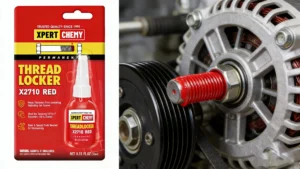
Product Insight: XPERTCHEMY® Threadlocker Permanent
For demanding motor and vibration applications, XPERTCHEMY® Threadlocker Permanent is engineered to deliver reliable, long-term locking strength. Its high resistance to vibration and mechanical shock makes it well suited for electric motors, gear assemblies, and industrial equipment where fastener failure is not an option.
Designed for professional use, XPERTCHEMY® Threadlocker Permanent helps reduce maintenance downtime and provides confidence in permanent threaded assemblies.
Conclusion
In motor and high-vibration working conditions, fastener reliability is essential for safety, performance, and service life. Threadlockers play a critical role in preventing loosening, maintaining preload, and reducing maintenance costs. By selecting the appropriate strength grade and following correct application practices, manufacturers and maintenance professionals can significantly improve the durability of threaded assemblies in demanding environments.