
Short Answer First: It Can Hold at First, Then Fail Later
Many installers have seen this confusing situation: a mixed-material joint appears fine during assembly, survives an early check, and then leaks days or weeks later. That delay is exactly why CPVC vs PVC cement compatibility matters. Solvent cement is not generic glue. The chemistry is tuned to the substrate family and expected service conditions.
If your system carries hot water, thermal cycling, or moderate pressure swings, compatibility mistakes become more visible over time. What looked like a “good weld” in hour one can degrade into a weak interface after repeated temperature and pressure changes.
Why the Chemistry Difference Matters
PVC and CPVC are related materials, but not identical. CPVC has higher chlorine content and different temperature performance. Cement formulas are adjusted to soften and fuse those materials correctly. When the solvent-resin balance does not match the pipe material, the weld zone may not form uniformly through the socket depth.
In practical terms, mismatch increases the chance of:
- incomplete fusion at the interface,
- micro-paths that become seepage points,
- reduced long-term strength under heat.
What Installers Usually Notice in the Field
Compatibility errors rarely announce themselves immediately. Instead, they show up as callbacks that are hard to diagnose:
- The joint passed basic startup checks.
- System runs normally for a period.
- A leak appears near a fitting shoulder or socket edge.
- The failure is blamed on installation speed, but root cause includes wrong cement selection.
This is why experienced teams standardize material pairing before work starts, not after problems appear.
What to Do for CPVC-to-PVC Transitions
Real projects often involve transitions. The safe approach is not guessing with whatever can is nearest. Use an approved transition strategy for the specific materials, service class, and local code environment. In some projects that means dedicated transition cement; in others, mechanical transition fittings are preferred.
Before committing any method, verify:
- pipe and fitting markings,
- service temperature range,
- manufacturer compatibility notes,
- inspection requirements for your jurisdiction.
A Better Decision Sequence on Job Day
- Confirm substrate type on both sides of the joint.
- Select cement for that substrate pair and temperature duty.
- Check shelf condition and viscosity before use.
- Prepare, deburr, and dry-fit correctly.
- Apply and assemble immediately, then respect cure timing.
That sequence prevents most avoidable compatibility failures without adding much labor.
Procurement Tip: Reduce Mixing Errors Before They Start
Many compatibility mistakes are stocking mistakes. If your warehouse shelves are crowded with similar-looking cans, crews can grab the wrong formula under time pressure. Label control and product standardization help more than post-failure troubleshooting.
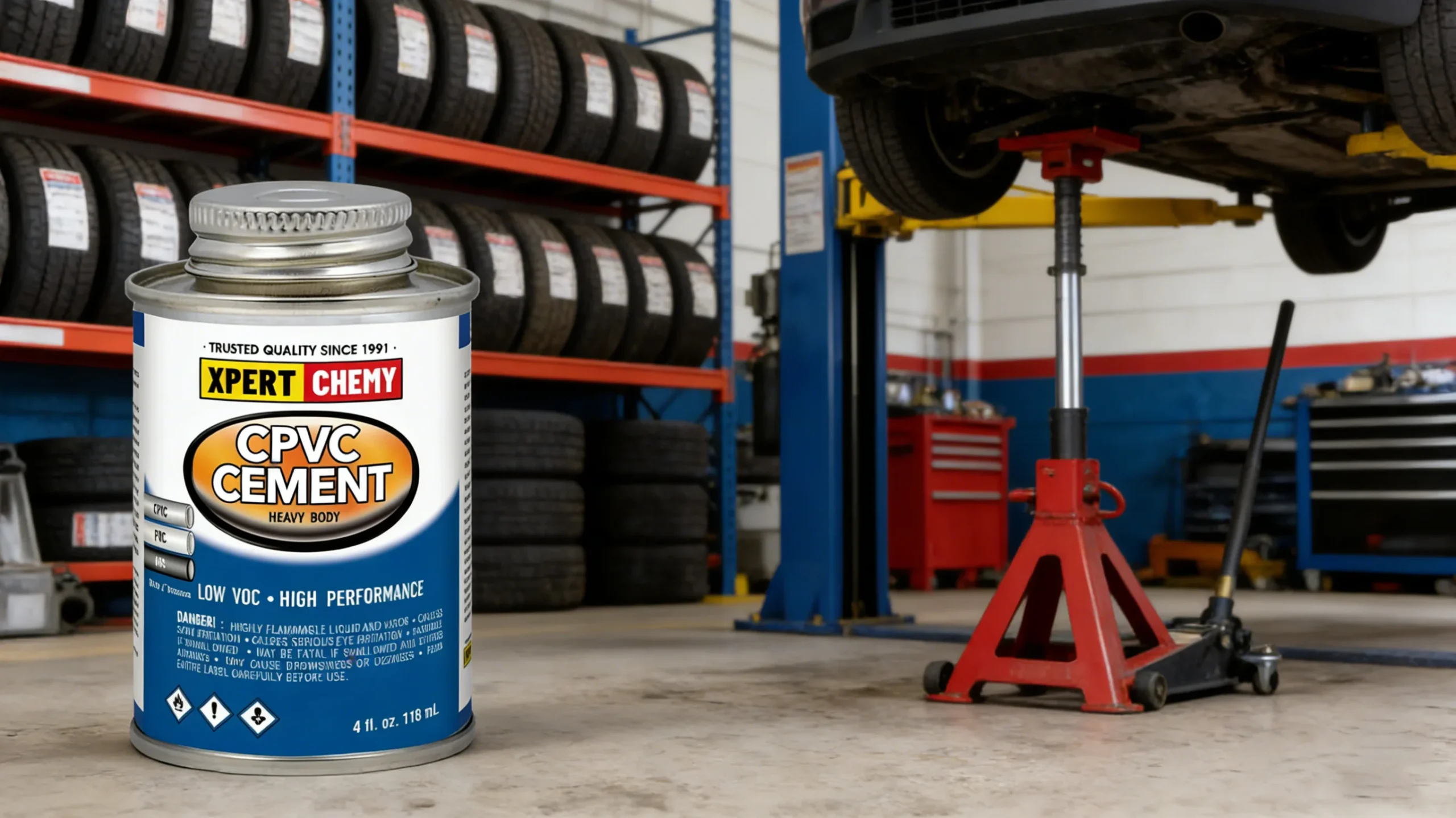
If you are sourcing for contractors, distributors, or project procurement, Xpertchemy Heavy Bodied CPVC Cement 118ml is available for wholesale supply. Keeping a consistent CPVC product line in inventory can reduce field-level confusion and improve repeatable installation outcomes.
Bottom Line
Mixing PVC and CPVC cement decisions is not just a technical detail. It is a risk decision. The cost of choosing the wrong can is usually hidden until after handover, when repair becomes expensive. Choose the chemistry deliberately, not conveniently.