Cyanoacrylate adhesives—commonly known as super glue—are valued for their instant bonding speed and high initial strength. However, improper use or incorrect product selection can lead to unexpected failures such as whitening, brittle bonds, or loss of adhesion at elevated temperatures. Understanding these common pitfalls and how to avoid them is key to achieving durable, professional results.
1. Whitening (Blooming or Frosting)
What Causes It?
Whitening, often called blooming or frosting, occurs when cyanoacrylate vapors react with moisture in the air and settle on nearby surfaces. This is especially noticeable on dark, glossy, or transparent materials such as plastics, rubber, and metal coatings.
How to Prevent It
-
Use the minimum effective amount of adhesive
-
Ensure good ventilation during curing
-
Avoid bonding in high-humidity environments
-
Choose low-bloom formulations designed for cosmetic-sensitive applications
Professional-grade products like XPERTCHEMY® Super Glue are engineered with controlled curing behavior, helping to significantly reduce whitening on visible surfaces.
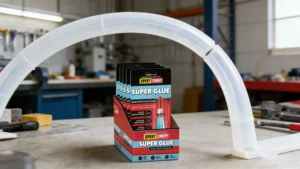
2. Brittle Bonds and Cracking
Why Super Glue Becomes Brittle
While cyanoacrylate adhesives provide high tensile strength, standard formulations can be rigid after curing. Under impact, vibration, or repeated stress, this rigidity may cause micro-cracks or sudden bond failure.
Practical Solutions
-
Lightly roughen smooth surfaces to improve mechanical bonding
-
Avoid thick glue layers—thin bonds are stronger and cure more evenly
-
For parts exposed to vibration or shock, use rubber-toughened or flexible-grade super glue
High-quality adhesives such as XPERTCHEMY® Super Glue are optimized for balanced strength and toughness, making them suitable for both precision repairs and light industrial applications.
3. Poor Temperature Resistance
The Temperature Limitation of Cyanoacrylates
Standard super glue typically performs best below 80–90°C. At higher temperatures, the adhesive may soften, lose strength, or fail entirely—especially in automotive, electronic, or machinery-related uses.
How to Improve Heat Performance
-
Confirm the service temperature range before selecting the adhesive
-
Keep bonds away from direct heat sources whenever possible
-
For elevated-temperature environments, select high-temperature-resistant cyanoacrylate formulations or alternative adhesives
XPERTCHEMY® Super Glue offers stable bonding performance within its specified temperature range, ensuring reliable adhesion in everyday and demanding repair scenarios.
Conclusion
Super glue is a powerful and convenient adhesive, but its performance depends heavily on correct usage and proper formulation selection. By understanding and addressing common issues such as whitening, brittleness, and temperature sensitivity, you can achieve cleaner, stronger, and longer-lasting bonds.
Choosing a well-formulated product like XPERTCHEMY® Super Glue not only simplifies the bonding process but also helps avoid many of the typical pitfalls associated with standard cyanoacrylate adhesives—making it a dependable choice for both professionals and DIY users.