
Threaded and interference-fit assemblies are widely used in industrial equipment where reliability under load and vibration is critical. Threadlockers play a key role in preventing loosening, fretting corrosion, and loss of preload across a range of demanding applications, from fixed studs to press-fit components exposed to continuous mechanical stress.
This article explores how industrial threadlockers are applied to studs, press fits, and vibration-prone assemblies, and why permanent-strength formulations are often specified.
Threadlockers in Stud Installations
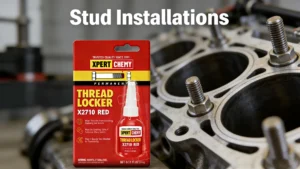
Studs are commonly used in engines, pumps, and heavy machinery where frequent removal of the mating nut is expected while the stud remains fixed in place. In these applications, threadlockers provide several advantages:
-
Prevent stud back-out during nut removal
-
Maintain consistent clamping force
-
Reduce the risk of fretting and thread wear
Permanent threadlockers are often applied to the stud-to-base interface, ensuring the stud remains locked even under cyclic loading and temperature changes.
Enhancing Press Fit Performance
Press fits rely on interference between components to achieve mechanical retention, but vibration, thermal expansion, and micro-movement can reduce holding strength over time. Anaerobic threadlockers and retaining compounds can be used to:
-
Fill surface irregularities between mating parts
-
Increase shear strength of the joint
-
Prevent corrosion at the contact interface
When used with press-fit shafts, bearings, or bushings, threadlockers help stabilize assemblies and extend service life, especially in rotating equipment.
Vibration Resistance in Dynamic Assemblies
Vibration is one of the most common causes of fastener failure in industrial systems. Equipment such as motors, conveyors, compressors, and gearboxes are constantly exposed to oscillating loads that can loosen traditional mechanical fasteners.
Threadlockers address this issue by:
-
Creating a solid polymer bond between threads
-
Maintaining preload under dynamic conditions
-
Eliminating reliance on lock washers or spring devices
Permanent-strength formulations are typically specified where disassembly is not part of routine maintenance and maximum resistance to loosening is required.
Material Compatibility and Surface Considerations
Industrial threadlockers are compatible with a wide range of metals, including carbon steel, alloy steel, and stainless steel. However, surface condition plays an important role in performance. Clean, oil-free threads ensure optimal curing and maximum bond strength, while inactive metals may require an activator to achieve full cure.
Selecting a Permanent Threadlocker for Industrial Use
When choosing a threadlocker for studs, press fits, or vibration-prone assemblies, engineers should evaluate:
-
Required locking strength
-
Operating temperature range
-
Exposure to oils, fuels, or chemicals
-
Disassembly requirements and service life expectations
Products like XPERTCHEMY® Threadlocker Permanent are designed for high-strength industrial applications where long-term vibration resistance and reliable fastening are essential.
Conclusion
Threadlockers are a critical component in industrial fastening strategies, particularly for stud installations, press fits, and assemblies exposed to continuous vibration. By selecting the appropriate strength grade and applying it correctly, manufacturers and maintenance teams can significantly improve joint reliability, reduce downtime, and extend equipment lifespan.