
When PVC jobs fail, people often blame the installer first. In reality, a large share of failures start with one upstream mistake: the wrong solvent cement system for the pipe material. PVC, CPVC, and ABS may look similar in a warehouse rack, but they are not chemically interchangeable in the field.
This article explains the compatibility rules that matter most for distributors, contractors, and project engineers who want fewer leaks, fewer callbacks, and fewer disputes.
Why Material Compatibility Is Non-Negotiable
Solvent cement does not simply stick two parts together. It temporarily softens mating surfaces so they fuse into one bonded interface. That fusion behavior depends on chemistry. If the cement system is mismatched to the plastic, the joint may appear acceptable at first and then weaken under pressure, heat, or vibration.
Core Rules by Material Type
- PVC to PVC: use a PVC-rated solvent cement system suited to the application class.
- CPVC to CPVC: use CPVC-rated cement; CPVC services often involve higher temperature demands.
- ABS to ABS: use ABS cement designed for ABS material behavior.
Never treat these as interchangeable unless the product label and local code explicitly permit that use case.
The Most Common Failure Point: Dissimilar Plastic Transitions
PVC-to-ABS and other mixed-material transitions are where many avoidable failures happen. In many jurisdictions, transition joints require dedicated transition cement or an approved mechanical transition method. “Regular PVC cement” is not automatically valid for dissimilar plastics.
For CPVC transitions, service temperature and pressure class make rule compliance even more critical. If the specification is unclear, stop and verify before assembly.
Compatibility Is More Than Label Match
Even with the correct material family, joint integrity also depends on:
- Cement body/viscosity matched to diameter and fit.
- Surface prep quality (cut, deburr, clean, prime where required).
- Cure timing discipline before handling and pressure testing.
Correct material plus poor process still fails. Compatibility must be paired with execution control.
A Practical Compatibility Workflow for Crews
- Identify pipe/fitting material from markings, not by color assumptions.
- Verify the exact cement type against product label and job spec.
- Confirm whether primer is required by code and system instructions.
- For dissimilar materials, verify approved transition method before cutting.
- Record lot and batch information for traceability on critical jobs.
Warehouse Controls That Prevent Field Mix-Ups
- Separate PVC, CPVC, ABS, and transition products by zone.
- Use distinct SKU naming conventions and shelf labels.
- Train dispatch staff to avoid “substituting similar cans” during stockouts.
- Include a one-page compatibility card in outbound cartons.
Most compatibility failures can be prevented before the product even reaches site.
Frequent Misconceptions to Eliminate
- “If it bonds once, it is compatible.” False. Delayed failure is common.
- “Color tells me the chemistry.” False. Labels and technical data decide compatibility.
- “Any solvent cement works on any plastic.” False. Material-specific chemistry matters.
Commercial Note for Buyers and Distributors
If your channel focuses on PVC systems, XPERTCHEMY® PVC Solvent Cement 237ml is available for wholesale supply with stable packaging and replenishment support for distributor programs.
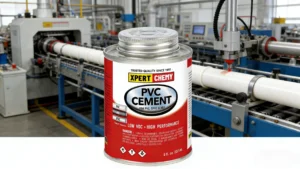
XPERTCHEMY can also support mixed-order procurement planning so teams can separate PVC lines clearly from other solvent systems and reduce field mix-up risk.
Bottom Line
Compatibility is not a minor technical detail. It is the foundation of joint reliability. Use the correct cement for the exact material, apply approved transition rules for dissimilar plastics, and enforce clear warehouse-to-jobsite controls.