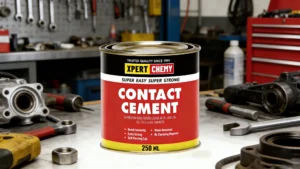
Contact adhesive—often called contact cement—is one of the most versatile glues available for DIY repairs, crafting, woodworking, and industrial assembly. Its ability to bond instantly, securely, and across many types of surfaces makes it a go-to adhesive for professionals and hobbyists alike. But what exactly can contact adhesive stick to? And how do you choose between a compact 25ml tube and a larger 250ml can?
This guide covers all the essential information to help you pick the right adhesive for your projects.
What Materials Can Contact Adhesive Bond?
Contact adhesive is known for bonding non-porous, smooth, and difficult surfaces. Thanks to its high initial tack and solvent-based composition, it forms strong, flexible bonds that resist heat and vibration.
1. Leather & Rubber
-
Ideal for shoes, belts, leather crafts, and rubber repair
-
Provides a flexible, durable bond
-
Common in footwear and upholstery repair shops
2. Wood & Laminates
-
Frequently used in furniture making and cabinetry
-
Excellent for bonding laminates to MDF, plywood, or particle board
-
Resistant to heat—suitable for kitchen worktops
3. Metal
-
Bonds lightweight metals such as aluminum and stainless steel
-
Useful for automotive trim, small repairs, and metal-rubber attachments
4. Plastics
(Bonds depend on type of plastic.)
-
Works well with ABS, PVC, acrylic, and some rigid plastics
-
Not ideal for PP and PE
5. Fabric & Foam
-
Suitable for craft projects, DIY upholstery, and costume making
-
Provides flexible, soft-to-the-touch bonding
6. Glass & Ceramics
-
Effective for attaching handles, repairing decorative pieces, or bonding mixed materials
Because of this wide compatibility, many users keep contact adhesive as a “universal fix-it” tool in their workshop or toolbox.
How to Use Contact Adhesive Properly
For best results:
-
Clean both surfaces to remove oil, dust, and moisture.
-
Apply a thin, even layer to each surface.
-
Allow 2–8 minutes for the adhesive to become tacky (depending on temperature/humidity).
-
Press surfaces together firmly—you usually get instant bonding.
-
Avoid repositioning once bonded.
25ml Portable Tube vs. 250ml Large Pack: How to Choose?
Choosing the right size depends on your usage scenario.
Xpertchemy® Contact Adhesive 25ml – Pocket-Sized Convenience
Perfect for:
-
Travel and on-the-go fixes
-
Quick home repairs
-
Crafting and small bonding tasks
-
A must-carry for leather enthusiasts or cyclists
Its compact design makes it easy to store in a drawer, toolbox, or glove compartment.
“If you need powerful bonding anywhere, the Xpertchemy® Contact Adhesive 25ml delivers portability without sacrificing strength.”
Xpertchemy® Contact Adhesive 250ml – Cost-Effective for Frequent Users
Best for:
-
Workshops and professional craftsmen
-
Furniture repair, woodworking, and laminating large surfaces
-
Bulk tasks requiring frequent application
Larger volume means better value and long-term availability.
“For heavy-duty bonding, the Xpertchemy® Contact Adhesive 250ml offers industrial-grade performance that professionals trust.”
Which Size Should You Pick?
Choose 25ml if you want:
-
Occasional use
-
Portability
-
Precision work
Choose 250ml if you need:
-
Frequent or professional use
-
Large surface bonding
-
Better cost-per-ml value
Many users keep both sizes—a portable one for emergencies and a large can for workshop projects.
Conclusion
Contact adhesive is a powerful, versatile solution for bonding leather, wood, metal, plastic, fabric, glass, and more. Whether you’re repairing shoes, building furniture, or tackling creative DIY projects, having the right adhesive size on hand saves time and effort.
With Xpertchemy® Contact Adhesive 25ml / 250ml, you get reliability, strong bonding performance, and options tailored to your needs—anytime, anywhere.